Domesday Book entry relating to Alverton, Cornwall
"Has anyone got any information and/or images of Alverton to share?"
- Paul Mason at buryanpaul@yahoo.com
Alverton: West
of Penzance
by Paul Mason
Ancient History
"At Tredarvah (Alverton) a Bronze Age (c.3500-1200 BC) settlement of unknown form was discovered under salvage conditions in 1963. There were no structures found, only pottery, bronzes and domestic debris including a large saddle quern. Both pottery and bronze are Middle Bronze Age (MBA c.2000-1600 BC), but as they cannot be shown to belong to the same stratigraphic layer they cannot be said to be associated together. Tredarvah appears to be a domestic site which was occupied with no observable break from the later part of the Early Bronze Age (EBA c.3500-2000 BC) through to at least the Middle Bronze Age. Bronzes and slag suggest that the metal working was carried out at the site." (ref: Cornwall Archaeology 16 - SW 464 303 {latitude 50.118482, longitude -5.5489527})
'The material from Tredarvah (published in Cornish Archaeology Vol. 16) was excavated in 1963. It consists of a metalwork hoard (palstave, spearhead, knife blades, whetstone, decorative pins, two bronze balls and a lump of goethite) and two boxes of other finds (consisting of a large quantity of pottery and a saddle quern). If you want a detailed description of the excavation and the above finds then the best report to read is in Cornish Archaeology Vol. 16 (pp. 25-41), but the site has also been published in Cornish Archaeology Vol. 3 (p. 85) and the metalwork in Pearce, S. 1983. The Bronze Age Metalwork of South Western Britain . British Archaeological Report (BAR) British Series Vol. 120 (ii), Ref. 120b. The metalwork and the saddle quern are on display in the [Truro] museum and the remaining finds can be viewed upon request.' - Laura Pooley, Curatorial Assistant (Archaeology), Royal Institution of Cornwall
"The only record we have for prehistory in the area (of Alverton) is an Iron Age (700 BC to 43 AD) round at Mount Misery." - John Smith, Senior Archaeologist of Cornwall Archaeology Unit
Alverton Manor
The origins of the name Alverton seem to date back before Domesday, to a Saxon lord called Alward who died at the Battle of Hastings. The word 'ton' is said to be Saxon for 'farmstead', 'estate', 'manor' 'hamlet', 'village', and even 'town'. We are told that 'Alwarton' was 'Alward's ton'; or 'Alward's manor'.
In 1086 the following entry was included in the Domesday Book (the original of this entry now appears to be lost):-
Domesday Book entry relating to Alverton, Cornwall
"The Count has manor which is called ALWARSTONE which Alward held T.R.E. (Tempora Regis Edwardi; in the time of King Edward the Confessor) Therein are 3 hides of land, and they rendered yeld for 2 hides. Sixty teams can plough these. Thereof the Count has in demesne half a hide and 3 ploughs and the villeins have 2½ hides and 12 ploughs. There the Count has 35 villeins and 2 bordars and 11 serfs and 1 rouncey and 17 unbroken mares and 9 beasts and 4 swine and 100 sheep and 3 acres of meadow and of pasture 2 leagues in length and in breadth. And it renders £20 yearly and when the Count received it, it was worth £8."
Alverton was a part of Connerton (sited near modern day Connor Downs) an administrative division known as a 'hundred', one of seven in Cornwall. Connerton Hundred had thirteen parts, with Alverton being relatively large, recorded as having some seventy-one households, With the passing of time the 'Connerton Hundred' became known as the 'Penwith Hundred'
Apparently "The Count" was Robert, Count of Mortain, (William the Conqueror's half-brother) who was given the land taken from Alward. Additionally, Count Robert owned a great deal more land in Cornwall and appears to have been a very powerful Norman Lord.
Lords of Alverton Manor
From 1095 to 1230 Alverton was owned by the Earl of Cornwall, after which Henry Le Tyes became Lord Alverton. Alverton stayed in the Le Tyes family until 1322 when the then Lord of the manor took part in a revolt against the king, Edward II, and was executed. In 1327 Alverton passed to Le Tyes' sister Alice Lisle. By 1466 Alverton had fallen into the hands of King Henry VIII. In 1611 George Whitmore bought the title and sold it to his father-in-law Richard Daniell in 1614. In 1635 Alexander Daniell became Lord Alverton after which the title then passed to Richard Daniell in, 1649, but by 1663 ownership of Alverton had changed hands again and was in the hands of William Keigwin whose family held Alverton until 1716 when Uriah Tonkin took up the title. In fact the Tonkin family then held on to the title of Alverton for a very long time, for almost two and a half centuries.
When Robert Edmund Tonkin died in October 1935, his sole heir, John Franklin Tonkin, acquired the Lord of the Manors of St. Buryan and Alverton. In 1960 J F Tonkin died in New Zealand and left the Lords of the Manors of St. Buryan and Alverton to his daughter, Gillian Green. Gillian Green held these to her death in 2004 when the title of The Lord of the Manor of Alverton was passed onto her daughter Sue Bedford and Tom Bedford (Sue Bedford's son). In 2005 Sue Bedford passed away and passed the title onto Fleur Carpenter (her daughter).
Location of Alverton
It is difficult to determine the precise boundaries of Alverton, but, for starters, it's likely that all properties in Alverton Street have at one time or another been considered to be a part of Alverton.
Alverne House in town was built by the Pascoe family in 1754. Alverne House at 30 Alverton Street was later home of Robert Hawker Peniel Preston (1838-1933), local artist and photographer.

St Johns Hall and Swann’s Wool & Toy Shop, Alverton Street, Penzance, 1939
(oil painting by Stanhope A Forbes 1857-1947)

Some might think of Alverton begining around about The First & Last in Alverton Road, an old inn which appears to date back to the late 18th Century, and then Wellington Terrace.

First and Last Inn, Alverton Street, Penzance c1880
(Gibson & Sons, Penzance)
- thanks to Bob Watts & Tony

Penzance Antiqurian Society members sit in coach parked outside the First and Last Inn, Alverton Street, Penzance c1890

First & Last Inn (and Alverton Dairy), Alverton, Penzance c1910
(postcard by Thomas of Penzance)


Postcard of Alverton Street, Penzance (postmarked 1909) - Frith's

Some little way further out of Penzance, on the North side of Alverton Road, is Chycelin (a Cornish name derived from chy = house and celin = holly). Fronted with grounds sporting magnificent Magnolia trees, Chycelin is set back from the street. The house was formerly called The Hollies, and before that, The Hollies Academy, a Gentlemen's Boarding School, opened in 1883 and owned by Joseph Alan Thorne. J A Thorne was later listed in The Edinburgh Gazzette of December 1893 as involved in bancruptcy proceedings. Henceforth, Hollies became a private residence, dwelt in by the family of a Prussian merchant called David Bischofswerder. Further, there is a 1893 Kelly's directory entry of a Sylvanus Hanley (probably the famous shell collector), living at The Hollies. David Bischofswerder. it appears, was a gold watch maker, and later a jeweller and pawnbroker, whose father was a rabbi. After the Bischofswerders, the Boase family moved into The Hollies, this Boase being a local solicitor.

Alverton School For Girls (now Alphington House Register Office), Penzance

Cornishman and Cornish Telegraph 15th May 1918
Alverton might reasonably be thought to start around Alphington House, at one time the Alverton School For Girls, and currently the Registry Office. Alphington House and The Weeths in Alverton Place were both built about 1830.

Horse-drawn charabanc parked in Alverton Road outside
Alphington House, adjacent to Weeth Cottages.
In top left corner of photograph is sign advertising Riviera Palace
Hotel
.........
The first buildings to be seen on the Alverton Road outside of Penzance are, on the left are:-
Alverne Hill
Henry Boase b 3 Jun 1763. d 8 Apr 1827 retired from banking in London 1809. Came to Penzance, and in about 1810, 'having purchased about two acres and a half of ground on the west, or Alverton, side of the town for £1000, he built a house there which cost him £3,500 more. It was first called Park Herbier house, after the name of the estate of which it formed a part, then Prospect place, since altered to Alverne Hill, and has a pleasant garden in which the well-known spring, called Alverton well, takes its rise.' Very quickly Boase joined in local banking. The house passed to the Jago family - Alverne Hill was also once a residence of William Bolitho the banker.
According to the 1871 census, Alverne Hill
was the home of John Hallet Batton and his family
Alverton Hill Alverton,1,John Hallet Batton,Head,M,59,,Civil Service
Retired,Amwell Hertfordshire,,Late Bengal
,,,Mary Sarah Batton,Wife,M,,45,,British India Overseas Brit. Subj,,
,,,George Beckett Batton,Son,,10,,Scholar,British India Overseas Brit.
Subj,,
,,,John Raye Batton,Son,,5,,Scholar,British India Overseas Brit. Subj,,
,,,Anna Mariah Beckett,Mtrlaw,W,,72,,\- Ireland,,
,,,Mary Donnithorne,Servnt,U,,26,Parlourmaid Domestic Servant,Penzance
Cornwall,,
,,,Margaret Carnell,Servnt,U,,25,Cook Domestic Servant,Lelant Cornwall,,
,,,Catherine Williams,Servnt,U,,25,Housemaid Domestic Servant,Redruth
Cornwall,,
,,,Esther Hancock,Servnt,U,,17,Laundrymaid Domestic Servant,Mullion
Cornwall,,
Courtney in 'Half a Century of
Penzance (1825-1875)' from notes by J. S. Courtney; Beare &
Son, Penzance: 1878 suggested that ... "Herbier House, Bellair
House, Alverne Hill, and Alverton Vean. were all built from 1812-1823
mostly before 1820."
"The cottage, now West Lodge, has been built long since 1825, likewise
Trevear and some other houses on the north side. Alverton Vean was
built by Mr. T. F. Barham, whose father for many years resided at
Leskinnick."
West Lodge
Alverton Manor - formerly Alverton
Vean built about 1840
According to the 1871 census members of the Boase family live at
Alverton Vean.
Alverton Vean Alverton,1,John Josias Arthur
Boase,Head,M,69,,Retired Banker & Landowner,Knightsbridge
London,,
,,,Charlotte Boase,Wife,M,,68,,St Clements Truro Cornwall,,
,,,Charles William Boase,Son,U,42,,Clergyman Ma Tutor Oxford,Penzance
Cornwall,,
,,,Julia Boase,Dau,U,,31,Madron,Penzance Cornwall,,
,,,Catherine Davy,Servnt,U,,37,Housemaide Domestic Servant,Manaccan
Cornwall,,
,,,Alice Banfield Champion,Servnt,U,,26,Cook Domestic Servant,Lelant
Cornwall,,
Alverton Vean was renamed Alverton Manor sometime after 1893, (that is to say that this is Alverton Manor in name only). Until recently the building was occupied by Walker Moyle Chartered Accountants. However, there has been redevelopment, with the main house now being turned over to residential units and an additional building being erected in the garden space for use by the accountants, and the new building, 'The Pavillion', is accessed from Trewithen Road.

The back garden of Alverton Manor, Alverton, Penzance
Nearby is an well that evidently used to serve the area, although these days the well is neglected, filled with debris and litter.

The Old Well, Alverton, Penzance
On the right of Alverton Road, behind the grand ornate balustrade stands Polwithen Lodge, built to serve nearby Polwithen House.

A photograph of Polwithen Lodge on Alverton Road, Penzance
Photo taken 1897 by Gibson & Sons of Market Jew Street, Penzance.
Published in 'Views and Reviews - Special Edition - Penzance'
1897, p15

Polwithen Lodge after the sale of Polwithen House, before the construction
of houses in Kings Road, Alverton, Penzance
Image copied from Polwithen Estate sales material which contains various
views of and from Polwithen
The Bolithos had long been in the tin mining business, and as money was advanced to miners to be repaid in tin it was natural they should also become commercial bankers. Back in 1807 Thomas and William Bolitho started The Mounts Bay Commercial Bank from their count-house at the Chyandour Smelting House.

William Bolitho, seated in carriage outside his home, Polwithen
House, Alverton, Penzance. Cornwall
[Courtesy Ken Jaggard, Bolitho School]
NB This might well be the only photograph of banker William Bolitho on the
internet?
Polwithen House - built in 1870 for the well-known
banker William Bolitho, but it seems that he is not able to enjoy the
appearance of the grand wooded estate, which stretches for some distance
along the Alverton Road, for according to the census of 1881 William
Bolitho is blind, lives with his
wife, Mary Hitchens Bolitho, two of his daughters, Nora and Loveday, and
some of their staff:-
Polwithen Mansion House,1,William
Bolitho,Head,M,65,,Banker,Penzance Cornwall,Blind,
,,,Mary Hichens Bolitho,Wife,M,,63,,St Ives Cornwall,,
,,,Nora Bolitho,Dau,U,,23,,Penzance Cornwall,,
,,,Loveday W. Bolitho,Dau,U,,19,,Penzance Cornwall
,,,Martha Rodda,Servnt,U,,51,Domestic Cook,Hayle Cornwall,,
,,,Eliz. A. Geach,Servnt,U,,50,Ladys Maid,Chasewater Cornwall,,
,,,Jane S. Roberts,Servnt,U,,38,Housemaid,Helston Cornwall,,
,,,Susan Langman,Servnt,U,,30,Ladys Maid,Looe Cornwall,,
,,,Ellen Richards,Servnt,U,,24,Under Housemaid,Madron Cornwall,,
,,,Sarah J. Warren,Servnt,U,,25,Kitchenmaid,St Erth Cornwall,,
,,,William Casins,Servnt,U,21,,Groom,Lostwithell Cornwall,,
,,,John R. Kelly,Servnt,U,21,,Footman,Devonport Stoke Devon,,
Curiously, in the 1891 census William Bolitho is listed not as a Banker or retired Banker, but
as a retired Bauxite & Tin Smelter
Living at Polwithen Lodge in 1881 were the gardener,
his wife, and nephew:-
Polwithen Lodge,1,Nicholas Dossett,Head,M,33,,Gardener,Hedgerly
Buckinghamshire,,
,,,Emma Dossett,Wife,M,,34,,Dalwood Devon,,
,,,James Herniman,Nephew,,11,,Scholar,\- Glamorganshire,,
Interestingly, an underground tunnel has been discovered leading off the
cellar under Polwithen Lodge that appears to head straight for Polwithen
House! One wonders what role it once played in the commercial and
domestic life of the Bolitho family?

Map of Alverton, Penzance, Cornwall
Reproduced from 1875-6 OS (1890 revision published 1895) Ordnance Survey
Map - for information only
Alverton Weeth Fields
Prior to the 19th Century the land to the West of Penzance was mainly open countryside with just a few cottages and farms to be seen along the lane out of Penzance and Alverton. The land on the North side of Alverton Road was referred to as Alvern-weith. These 'Weith' or 'Weeth' fields changed hands from time to time, and in a record of 1839 it states that; 'Another part of Lariggan, consisting of fields called the Weeths, measuring nearly 5 statute acres, was sold in 1781 for £483., and was again sold in 1824' - 'A Statistical Account of the Parish of Madron, Containing the Borough of Penzance, in Cornwall', Richard Edmonds - Journal of the Statistical Society of London, Vol. 2, No. 4 (Jul., 1839), pp. 198-233 doi:10.2307/2337707 http://links.jstor.org/sici?sici=0959-5341(183907)2%3A4%3C198%3AASAOTP%3E2.0.CO%3B2-Q
.In 1842 the Weeth fields are elsewhere recorded as being called the Alverton Weeths (on Tithe Map apportionment?). It has been suggested that 'Weeth' might mean willow, and willows were used in the local production of basketwork. It can be seen that both Polwithen and Trewithen contain the word 'withe'. The 1875-6 edition of the Ordnance Survey (OS) shows the "Weeth" fields as being numbered No.1698 & 1694.
>>
Along from
Polwithen Lodge, on the South side of the road is an old thatched
cottage which dates back to about 1670.
The thatched
cottage now called Hawke's Farm was formerly known as Alverton Farm,
and is thought to have been associated with Alverton House.
Across the road lay the ramped access route to the
Weeth fields, and that lane to the fields survives to this day.
Hawke's Farm
In 1841 a Richard Hawke from Perranuthnoe, is employed as a Flour Store Keeper, at the farm, and is living with his wife, Rosetta, and their year-old son, Walter, in Alverton Lane.
By 1851 Hawke is listed as a Bailiff and Store Keeper, and has a daughter, Jessie, and another son, Cornelius, and living with them is a servant.
In 1861 the census shows:-
Alverton Lane,1,Richard
Hawke,Head,M,43,,Bailiff And Store Keeper,Perran Cornwall,,
,,,Rosetta Hawke,Wife,M,,51,,Paul Cornwall,,
,,,Walter T Hawke,Son,U,20,,Clerk Flour Milling,Penzance Cornwall,,
,,,Jessie R Hawke,Dau,U,,15,Scholar,Penzance Cornwall,,
,,,Cornelius R Hawke,Son,U,14,,Scholar,Penzance Cornwall,,
,,,Ellen Alliston,Niece,U,,9,Scholar,\- London,,
,,,Grace Jennings,Servnt,U,,23,House Servant,Ludgvan Cornwall,,
In 1864 Richard Hawke is described as a Miller at Alverton Farm, then, in 1874, as a Clerk in the Flour Trade.

When Richard Hawke died in 1881, aged
63, his wife Rosetta continues to run Hawke's Farm - she is listed as having been
in business as a Dairy Farmer, assisted by three staff. However, by
1891 the farm cottage had new occupants, John Michell
Pearce, a 'Farmer and Manure Merchant', and his family. But by
far the most famous resident of this pretty cottage was Edward Pellew
who after a long, distinguished and famous naval career. attained to the
title of Admiral Lord Exmouth.
[Doesn't Pellew's history merit a
Blue Plaque or
similar at Hawke's Farm?]
UPDATE:
Over two years after raising the above question on this
webpage, on
July 21st 2011 it was announced in the press that
Hawke's Farm has been awarded a 'Penzance Heritage Plaque'. Hopefully,
the
Penzance Town Council blue plaque will soon be upgraded
and become a properjob English Heritage Blue Plaque.


Hawkes Farm, Alverton Road. Penzance c1902
opposite the farm can be seen the ramp to the gated entrance of the lane
providing vehicular access to the back of Greenbank
& to several Edwardian houses,
[from collection of Colin Ward]

Hawkes Farm, Alverton Road, Penzance c1902
[Robert Preston photo included in Mate's
Illustrated Penzance c1902]
In 1878 some notes made by J S Courtney were published in which he mentions the thatched cottage alternately known as Hawke's Cottage and Hawke's Farm:-
' Hawke's cottage, tradition says, was once the home of Admiral Pellew (Lord Exmouth).
'When Samuel Pellew died in 1765, Constance Pellew moved back to Penzance, with her children. They lived at Hawkes Farm, Alverton; one of two thatched cottages that remain in Penzance to this day. The house was owned by her mother.'
In 'Traditions and Hearthside Stories of West Cornwall - Ist Series' by William Bottrell, 1870, on pages 159-161, he tells:-
'We have a view of an old cottage which ought to be regarded with much interest, as it was the home of Pellew (Admiral Lord Exmouth) during his boyish days. Here he lived with his aged grandmother, Madam Woodhouse, until he left to commence his career of usefulness and glory that added much to the renown of the British nation. I have heard many anecdotes of the hero's boyish days from an old lady in the west country (the daughter of a gentleman farmer of Sennen), who when a girl in her teens, was sent to Penzance to reside with her uncle and aunt, that she might a attend a better school than was to be found in the country. At this time boys and girls often went to the same school until they were much older than it would be considered decorous for them to remain together in these thin-skinned, fastidious times.
Young Pellew went to the same school as the girl from the Land's-end, who, being two or three years older than the boy, called for him at his grandmother's house (the old thatched cottage near the Alverton entrance to Fox's gardens); but the country girl always had a hard task to get him to school, and often, in spite of all she could do, and the threats of the old lady's cane, young Pellew would take off to the Quay, whither the girl had to follow, as, if she was known to have let him escape, she would get a sound thrashing from her own aunt, who was a great friend of the boy's grandmother and paid the same attention to Edward Pellew as to her own children. As soon as they reached the pier he would spring into the first boat he found afloat, cast off the painter, and away to sea, without staying to notice if there were oars in the boat or not. His companion and guardian in petticoats would remain on the battery rocks, or pier, with her knitting or needlework, that she might signal to Pellew when it was time for him to come in, to return home to dinner. Often the fishermen and sailors at the quay, who all loved the daring boy and kept a watch over him, would go out in another boat and help him to come ashore in time to save his bacon; sometimes one or other, or both, of the old ladies would find out the truants, come down to the quay after them, and beat them both home to Alverton-lane, where Pellew would take refuge with old Mr. Boase, who always took the boy's part, as well as that of his niece (the west country girl) in spite of all the old ladies and the schoolmaster might say. To make amends for the beatings the Sennen girl got for letting Edward Pellew escape from school (which she liked to do very well herself now and then), and for doing his sums for him (whilst he occupied himself in making boats and ship's gearing under the desk), he would often drive her uncles's cows from the Weeths (the ground that is now Mr. Bolitho's lawn) down to Alverton to water, or bring them home to their yard in Alverton-lane to be milked of an evening. As he was soon taught to be a famous boxer by his friends the sailors of the quay, who would always have him with them if they could, he wanted to put his science in practice by thrashing any boy double his size, if they happened to offend his protectress, who, when fourscore years of age, has often shown me a lot of trifles Pellew sent home to his grandmother for his old schoolmate; among other things a variety of perforated foreign coins, such as sailors like to suspend from their watch chains, a pair of lady's silver shoe-buckles, &c.
When Pellew went to sea the old lady his grandmother used often to say, "If I could live to see my Teddy made a captain I would die contented." The old lady lived long enough to see him knighted, and I think made an admiral, before she died.
It is said that Pellew only once ran from the foe, and that was a woman. The story goes that when home on a furlough, one day he and his comrade "did a shooting go." They passed up Pulgoon lane, and when they came in the rear of the cottage in Castle Horneck avenue, which was then inhabited by two elderly spinsters, Pellew or his mate, for a bit of fun, fired a few shots through the latticed window of the spence, and made the old maidens' pewter platters ring. Away the lads scampered, as fast as they could run. They had scarcely passed the stile in Polgoon lane, when they heard and saw a long-legged raw-boned dame coming after them full chase, with the fire-hook in one hand and her hat in the other. Then it was a race for dear life. Away they went at a slapping pace, as fast as they could fly. Up in Lesingey the old dame dropped her hat and stopped a moment to tuck her skirts under her apron-strings. Leaving hat and hook on the road, away she flew for a new chase, and gained so much on the sailor that he had to drop his heavy musket in Polteggan lane, and just turned the corner in Madron churchtown to take the other road back to Penzance, when the old maid was nearly up with him; but when he turned the hill, and the dame saw him going down the lane like a hare, she turned tail and gave up the chase. On her way back she gathered up the spoil abandoned by the retreating foe, as well as her own arms and clothing, dropped in the heat of the chase.
How Sir Edward Pellew would have none, or few, but Cornishmen for his crew; how the Mount's-bay and St. Just men would volunteer for him, when the press-gang (who wanted men, and the devil a man could they get for other ships but his) were beaten out of Mousehole by the women, led on by Ann St. Doyd (Ann's right name was Pentreath), armed with the red-hot poker, is well known.
As every incident of his life, after he went to sea, became matter of history, we cannot claim any more of his life as belonging exclusively to Penzance.
The Western Approach to Penzance (Alverton Lane)
From the house in which Admiral Lord Exmouth passed his boyish days, there was a pleasant footpath, long after that time, through the fields to Alverton, seperated from the lane by a high hedge and shady trees; and the lane itself, from the Ellis's mansion (or the site of the "Western" Hotel) to the seat of the Daniels in Alverton (or probably the Jenkins at this time), was like a bower all the way, with the overhanging trees, except a good strip of green extending from Buriton House down almost to the pathway leading to Alverton well. On this green the fair was formerly held; - it has but recently been removed to a field. All the highroads at this time were pleasant green lanes. There was no such thing as a cart west of Penzance."
In all probability Edward Pellew lived at Hawke's Farm from 1765 when he was eight until the age of thirteen, when he is said to have run away from grammar school in Truro in order to go to sea. It is said that not long after he deserted, due to unfair treatment meted out to another midshipman. Notwithstanding this shakey start, Edward Pellew went on to become a lieutenant and then a captain before distinguishing himself sufficiently to be knighted by King George III at St. James' in 1793.

http://www.gracegalleries.com/Shipwrecks.htm
Sir Pellew is said to have saved the crew of the Dutton East Indiaman at Plymouth on 26th January 1796. In 1815 Pellew is awarded the G.C.B., the Knight's Grand Cross.

Viscount Exmouth, Admiral Edward Pellew 1757- 1833
According to Raymond Forward of Alverton:-
'One of the great sons of Penzance was Lord Exmouth - Edward
Pellew.'
Further information:- http://freepages.family.rootsweb.com/~treevecwll/exmouth.htm
Another seafarer lived at the house next door to Hawke's Farm Cottage, at Alverton Cottage, as J S Courtney mentions:-
'Captain Coffin built Alverton Cottage, and on this account it was called by the Rev. C. V. Le Grice "Sepulchre Hall." In it have lived a Mr. Collins, an artist, and for many years Mrs. William Peel, who took great pleasure in her garden, and introduced into it many foreign shrubs not usually grown in England in the open air.' So, the cottage could have been built sometime in the late 18th century or the early 19th century?
Susannah Allen (sister of John Allen, Military Knight of Windsor) lived for many years in Penzance, she died in The Cottage, Alverton. 22 Jan 1858 Age 80. Her husband was William Peel, 4th son of William Peel of Peel Fold, Lancaster. William Peel of Peel Fold, b 1745; eldest son of Thomas Peel, lived in Penzance and Trenant Park (Cornwall), who had died in 1843.

'Alverton Cottage, Penzance'
a very old snapshot of
South face of the thatched cottage c1860
More recently Alverton Cottage was owned by a Dr Cuthbert Lockyer, former Vice-President and consulting gynaecologist at Charing Cross Hospital London, who retired here with his wife Violet in 1930. The cottage used to have a thatched roof which was burnt by the gardeners boy, allegedly trying to shift some paint with a blowtorch, in 1935. Evidence of this are the windows upstairs which are relatively recent additons, for as the fire came under control the downstairs was left virtually unaffected.

Fire fighting at Alverton Cottage
According to an obituary published in the British Medical Journal, Lockyer had turned the rooms above the 'garage' [The Coach House], into a studio, and with his wife spent a lot of time painting and etching - they also enjoyed gardening, and grew sub-tropicals with success and pleasure. Dr Lockyer passed away in 1957 at the age of 90. His wife lived out the rest of her life alone at Alverton Cottage, until her passing in 1975.
Later, whilst the Mr & Mrs Timms were
living at Alverton Cottage, the property received attention in an issue
of the Country
Living magazine.
More recently, the current owners met a lady from Alexander Road who
apparently reported the thatch fire when she was a small girl!
~
The Orchard (currently
the YMCA) 'The Orchard was erected by Mr. Sam John, solicitor.' Samuel
JOHN
born 2 Sep 1773, son of William John of Penzance. Samuel John became a solicitor with
his brother George in 1812. George
John was Town Clerk, then Mayor 1812 and 1818, George John lived at Rosemorran (Gulval).
Samuel John built The Orchard between 1815-1820, but left Penzance on the 29th August 1829, to Paris where he died.
In the 'Examiner', dated 13th September 1829, there is a mention in the Police report from Bow Street, London, which refers to Samuel John:-
A rough estimate of this sum of
£30-40,000 today is calculated to be at least £2-3 million.
Had the charges been proven the punishment for this forgery would
almost certainly have been execution.
John Richards resident 1837
John Trevelyan was resident at The Orchard 1843.
Samuel Higgs, Mayor of Penzance, resident 1853
Thomas Dark resident 1856
The 1864 Coulson's Directory of
Penzance records the occupant of The Orchard as being a Thomas H B
Fellowes esquire, RN Inspecting Commander, Coast Guard. Commander
Thomas H Butler Fellowes was decorated whilst serving on HMS
Dryad during the campaign in Abyssinia in 1867-68.
Rear Admiral Sir Thomas Hounsom Butler Fellowes KCB died in
1923 at the age of 96.
Further information: http://www.pdavis.nl/ShowBiog.php?id=1460,
http://www.britishmedals.net/files/abydryad.htm & http://en.wikipedia.org/wiki/Thomas_Hounsom_Butler_Fellowes
The 1881 census has William T White, 62, a retired surgeon from Mortlake, London, his wife Elizabeth White, 60, and their servant, Jane Trembath, 34, living at The Orchard.
The 1891 census presents a somewhat
altered picture:-
The Orchard,1,Elizabeth White,Head,W,,70,Living On Her Own
Means,,Blackfriars Road London,,
,,,Arthur White,Son,S,43,,Retired Analytical Chemist,,Hendley
Worcestershire,,
,,,Jane Trembath,Servnt,S,,43,General Domestic Servant,,Morvah Cornwall,,
And according to Kelly's, Mrs
White was still living at The Orchard in 1893.
By the 1950's The Orchard had become an upmarket Bed & Breakfast establishment run by Mrs D S Pott.

Since its purchase in 1951 for £6,500 by the YMCA, the old main building at The Orchard has become greatly extended..
'Alverton House, built about two hundred years ago, has undergone many alterations and enlargements.' (J S Courtney c1875). There is a stone embedded in the front of Alverton House displaying a date of 1674.
Coulson's has a Mr Charles Edmondes, lodging-house keeper here at Alverton House in 1864.)
J(ohn) S(ampson) Courtney himself lived at Alverton House until his death on 10th February 1881
The 1881 census lists:-
,"Alverton Rd, Alverton Hse",1,Margaret A.
Courtney,Head,U,,46,Gentlewoman,Penzance Cornwall,,
,,,James Courtney,Brothr,U,40,,Retired Ship Master,Penzance Cornwall,,
,,,Richard A. Courtney,Brothr,U,33,,Accountant,Penzance Cornwall,,
,,,Louise D. Courtney,Sister,U,,31,,Penzance Cornwall,,
,,,Elizth. J. Hocking,Servnt,W,,47,Domestic S Cook,Penzance Cornwall,,
,,,Elizth. J. Hocking,Servnt,U,,18,Housemaid,St Just Cornwall,,
,,,Thomas Johns,Servnt,U,21,,Groom,St Just Cornwall,,
The 1891 census offers the following:-
Alverton House,1,William H. Borlase,Head,M,37,,Solicitor,Employer,Madron
Cornwall,,
,,,Caroline E. Borlase,Wife,M,,37,No Occupation,,Pundle
Northamptonshire,,
,,,Charlotte E. Clay,Visitr,S,,33,,,Great Addington Northamptonshire,,
,,,Jane Allen,Servnt,S,,24,Housemaid Domestic Servant,,Sithney Cornwall,,
,,,Mary Richards,Servnt,S,,40,Cook Domestic Servant,,Penzance Cornwall,,
,,,Elizabeth Sampson,Servnt,W,,51,Retired Servant,,Newlyn Cornwall,,
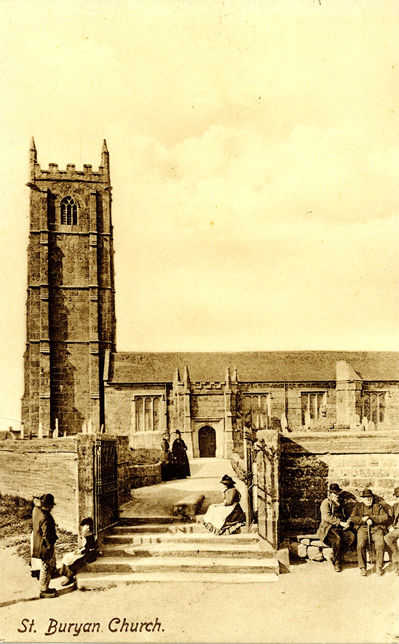
In Kelly's directory of 1893 is listed as resident at Alverton House, Robert Hawker Peniel Preston, a local artist and photographer, who it should be noted produced some very attractive local views, not least his study of Hawke's Farm and all the other excellent photographs that appeared in Mate's Illustrated Penzance c1902. Robert Preston's most famous photograph is the one taken outside St Buryan Church showing a young lad wearing a cap upon his head and sporting a hand-me-down girl's frock.
~
'These three last houses are on the lands of the Hawkin's family. Between the gardens of the Orchard and Alverton House was for many years a woollen cloth manufactory. but this gradually died away, and finally came to an end in 1830.'
'Alverton on the right, after passing the houses, has been much changed; there was a field, not separated from the road by any hedge, commencing where Polwithen Lodge now stands, and then came a narrow pathway with trees on both sides, ending near Alverton House, at the town boundary, in a picturesque stile. This pathway was much higher than the present terrace.'

'Luke Rowes Cottage', Alverton
'After some time it was cut down and the road widened, but this did not happen until I had been in Penzance many years; in fact the road was not much wanted, as the carriage traffic was very little, and the copper ores, etc., from St. Just, were brought to town for shipment on mules' backs. Hichens, of Lanyon, kept a large number of mules for that purpose.'

Until the latter part of the 19th Century the cottage appears to have abutted onto a substantial amount of cultivated land which was eventually sold off to form the Tredarvah Estate, upon which Tredarvah House now stands, built for the Harveys of Hayle in about 1885.
The
1891 census for Luke Rowe's household is as
follows:-
Alverton,1,Luke
Rowe,Head,M,69,,Market Gardener,Employer,St Levan Cornwall,,
,,,Emily Rowe,Wife,M,,64,,,Madron Cornwall,,
,,,Albert E. Rowe,Son,S,25,,Market Gardener,Employed,Madron
Cornwall,,
,,,Emily Rowe,Dau,S,,23,,,Madron Cornwall,,
,,,William H. Chapell,Grnson,S,11,,Scholar,,"Australia,
Adelaide Overseas Brit. Subj",,

Luke Rowe's Cottage, Alverton, with newly built boundary wall, in the snow
c1891

Luke Rowe's cottage, Alverton c1902

Tinted picture postcard of 'Old Cottage,
Alverton, Penzance', 1908
Frith's No.59460
Luke Rowe died at 72 years of age and was buried on 10th December 1893.
'Luke Rowe's Cottage' later became 'Willie Worth's Cottage' - William Worth was also a Market Gardener, who died c1970, and is still remembered locally, as are the apples he gave away!

View towards Penzance from where auction rooms at Auction
are now sited
Photograph by Gibson

View towards Penzance from
thatched cottage (known today as Tredarvah Farm),
of the long-since demolished cottages along Alverton Lane
(enlargement of detail from previous photograph)
Photograph by Gibson.
There is a beautiful and very colourful painting by a teenage J T Blight (1835-1911) in storage at Penlee House, Penzance, depicting the curious custom of 'beating the bounds' of Penzance. A collection of people are seen congregated about the boundary stone just opposite to Alverton House. Incidentally, this appears to be the same J T Blight FSA (FSA=Fellow of the Society of Antiquaries) who later wrote 'A Week at Land's End', published 1861, who also made his mark as both archaeologist and as an artist.

"Beating the Borough Bounds" at Alverton - oil painting by J
T Blight, 1853
'This depicts Mayor Samuel Higgs 'Renewing the Borough Bounds' at Alverton
Bound-Stone, Penzance in 1853.'
(Artist appears to be facing towards Penzance with boundary stone to
the left, and to the right, The Orchard, residence of Mayor Samuel Higgs,
now the YMCA.)
The pathway near the thatched cottage, on the North side of Alverton Road used to lead off towards Madron, to the farms of Rosehill and Roscadgill.
According to the 1906 OS map the land over the road from Tredarvah Farm, on the East side of the river Lariggan, is designated as "Fellmonger & Yard" (a fellmonger is one who deals in 'fells' or pelts - who separates the wool from sheepskins). Local lore has it that beyond the Lariggan River (that now runs beneath the bridge which was built in 1885, but which was then a ford), lay the Hanging Field to the north and a tanning works to the south, in what is now the car park of The Pirate Inn. 'The Pirate' itself dates back to the 17th century when it was built as a farmhouse. There is a stone on the front wall yielding a date of 1674 and some initials, there is also another stone dated 1701 with different initials. In those days there were other farm buildings here too, all belonging to Alverton Farm and clustered around the East side of the top of Love Lane. The farmhouse was turned into a public house in 1955, apparently in order to serve the local residents.
A short walk down Love Lane and another old cottage can be found to East side of the lane, with a date stone of 1675.
1844 Promenade constructed.
1865 Alexandra Road constructed
1879 Morrab Road, Hawkins Road & Trewithen Road constructed
Bolitho Bank and Penzance Bank
In the late 19th Century, Bolitho Bank and Penzance Bank (formerly known as Messrs. Batten, Carne and Carne) are two of the largest British banking concerns. On 30th November 1895, at the age of 80 years old, William Bolitho the well-known banker dies. The tin industry has fallen into decline. The Penzance Bank ceases trading and is wound up in 1897.
Polwithen House for sale
William Bolitho's widow Mary Hitchins Bolitho (née Yonge) outlives her husband by 6 or 7 years, and dies in 1902. Then, Polwithen House, Polwithen Lodge and all the surrounding land are put up for sale.
In 1905 Messrs. Bolitho & Co Ltd, Consolidated Bank of Cornwall is taken over by Barclays Bank (it has been suggested that the Bolithos were actually the founders of the world famous Barclays Bank). Bolitho Estate is aquired by Clements Inn Safe Deposit and Contract Company who proceed to sell off about eighty plots of land on the Eastern Weeth field. Polwithen Lodge is sold off too and gradually the area is developed. New roadways are built - Kings Road, Polwithen Road and Clements Road.
Polwithen House re-opens as the Riviera Palace Hotel and is first licensed in February 1906. Two years later, in 1908, architect Henry Maddern builds an extension onto the property.

Polwithen House as the Riviera Palace Hotel, Alverton c1910

Tinted picture postcard of Riviera Palace Hotel, Alverton c1910
M
Map of Alverton, Penzance
Reproduced from 1906 Ordnance Survey Map -
for information only

Polwithen sales plan 1906

The first houses to be built on the Polwithen Estate are at the head of Kings Road, on the right, a pair of semi-detached dwellings inspired by a visit to the Welwyn Garden City in 1906.


Polwithen Road, Penzance
- postcard -

View up Alexandra Road towards Alverton Road, Penzance
[Robert Preston photo included in Mate's
Illustrated Penzance c1902]

View up Alexandra Road towards Alverton Road, Penzance 1908
[Frith's, No.61230A]
According to the OS map there is a drinking fountain at
the top of Alexandra Road situated just a few yards east of Greenbank,
(where now is the wooden bench across the road from Alverne Hay.
Some may remember Alverne Hay as a hotel, where it is rumoured The
Beatles once stayed.

Alverne Hay, Alverton, Penzance
Illustration from advertisement in 'Penzance on the Cornish
Riviera' booklet, 1968, p41
Westcliffe, Foys, Mont Alverne and Sycamores are built circa 1908 and sold as Freehold properties. Both Westcliffe and Foys (c1907) deploy the architectural skills of Henry Maddern, whilst Sycamores is designed by Oliver Caldwell for Jabez Bunt.

Western Union Telegraph & Cable Company Office, Alverton, Penzance
c1912
In 1912 architect Henry Maddern builds the Western Union Telegraph & Cable Company Office on the plot of land between the Sycamores and Polwithen Lodge. At about that time Western Union cable service was reputed to be the largest in the world with 8 Duplexed Atlantic cables, over 25,500 offices and 1,500,000 miles of wire. Photographs of the inside workings of the Alverton Office can be located online at http://www.penleehouse.org.uk/search/?q=Western+Union. Further information and photographs can be found at http://atlantic-cable.com/CableCos/WU-Penzance/index.htm


Over the years the building has became used as the Alverton Court Hotel, and a nursing home, and more recently, after redevelopment, as an apartment building; Alverton Court.
* * *
Girls Boarding School
Towards the end of World War I, in 1917, the Riviera Palace Hotel is closed.
Riviera Palace Hotel becomes a Church of England High School for Girls. Later, in 1928, on joining the Woodward Corporation, it becomes the School of St Clare. In 1924 Rosamunde Pilcher was born in Lelant, a former pupil she used her recollections of life at the boarding school in her televised novel 'Coming Home', starring Peter O'Toole and Joanna Lumley. More recently the school has become co-educational, so in 1997 it changed its name to The Bolitho School.
Back in Rosamunde Pilcher's childhood, in the 1930's, redevelopment had already occurred in the area we now know as Kings Road and Clements Road, but the area of Tredarvah Road was still open country. Rosamunde would probably have sometimes trodden the back path from the main house between the fields, down to the Alverton Road just beyond Greenbank. A former occupant of Greenbank Mrs Anne Buchanan vividly remembers the field to the back of her house then, when anemones grew here and chrysanthemums too.
Greenbank
In December 1898, the new owner of "Weeths" field, Thomas Rodda (pork butcher), and a local speculative builder, Edward Pidwell (b.1853), together make leasehold agreements for the sale of the plots of land and the erection of a terrace of houses to be known as Greenbank. It is believed that construction of the terrace commenced in 1900 and that the first house built was Roseleigh. Further, it is suggested the design was by Penzance architect Oliver Caldwell and the building completed by 1906.

1940 revised OS Map showing undeveloped area of
Clements Road, Alverton, Penzance
note the pathway from school to Alverton Road

1946 ariel photograph
of Alverton showing Clements Road area, with Greenbank and Weeth Field to left

1967
OS map of Greenbank and surrounding area after redevelopment of Weeth
Field, Alverton
- for information only
According to the artist Margo
Maeckelberghe, who with her doctor husband lived at Greenbank during
the 1960's, the
terrace was known by many as 'Captains Row' on account of the many sea
captains who lived there. Whilst at Roseleigh, 11 Greenbank, the Maeckelberghes hosted students, amongst
them a daughter of the King of Somalia and a daughter of Emperor of
Ethiopia, Haile Selassie. Margo recalls the then
Prime Minister Harold Wilson phoning her, whilst
he was on his holidays in the Scilly Isles, to
obtain progress checks on her charges.
When the Maeckelberghes decided to move from Greenbank, their house
was purchased by Peter and Mary Ellery (of Tremean Pottery fame), who
received unexpected visitors, as Mary recalls:-
To the West of Greenbank lies the remnants of a narrow track that used to lead through to the fields to the back of Polwithen House and York House. York House was known as 'The Vatican' since it was built for a Mr. Pope. York House is now part of Penwith District Council's administrative headquarters. From here one could also walk to Nancalverne and Roscadgill.

Taking the lane North of Tredarvah Farm, alongside the babbling Lariggan River one passes to Alverton Lodge before arriving at Polgoon Farm. The road then climbs steeply up to the early Georgian manor house of Castle Horneck. Built in the late 18th century it was home to the Levelis and to the Borlase families.
'The Descent. Name and Arms of Borlase of Borlase in the County of Cornwall', Borlase. W.C., 1888, might be of interest to anyone investigating the Borlase connection.
By the mid 20th century the once grand house was being used by a local farmer to store potatoes and was purchased by the YHA, the Youth Hostel Association in order to provide temporary accommodation for visitors from all over the world.

Nearby to Castle Horneck, a little farther over to the
North-west is Rosehill. Rosehill Manor was built in 1814 by Robert Hitchen, and was originally
the home of a partner of the Penzance Bank; a 'merchant and former High Sheriff of Cornwall, Richard
Oxnam. He got into great financial troubles and at the suit of George
John, solicitor, Oxnan was sent to prison for many years. He died in
Penzance in 1844.'
Above Castle Horneck lies Lesingey Round, an ancient lookout post with fantastic views of the surrounding countryside and Mount's Bay.
Lariggan Bridge
Modern housing west of Lariggan Bridge, Princess Royal Estate, was started 1949 & completed 1953, whereas Penalverne Estate, in town, had been built back in 1931.
Pirate Inn

Additional information:-
Coulson's Directory of Penzance - 1864
http://west-penwith.org.uk/coulson1.htm
Half a Century of Penzance (1825-1875)
http://west-penwith.org.uk/pz1.htm
http://west-penwith.org.uk/pz2.htm
http://west-penwith.org.uk/pz3.htm
http://west-penwith.org.uk/pz4.htm
http://west-penwith.org.uk/pz5.htm
'The History of the Town and
Borough of Penzance' by P. A. S. Pool, The Corporation of
Penzance,
Cornwall Guide: A History of Penzance
http://www.cornwalls.co.uk/Penzance/history.htm
Traditions and Hearthside Stories of West Cornwall, Vol. 1 by
William Bottrell
http://www.sacred-texts.com/neu/celt/swc1/index.htm
Census listings for
Alverton, Penzance
1861 http://freepages.genealogy.rootsweb.ancestry.com/~kayhin/61594b.html
1871 http://freepages.genealogy.rootsweb.ancestry.com/~kayhin/72341.html
1881 http://freepages.genealogy.rootsweb.ancestry.com/~kayhin/82345.html
1891 http://freepages.genealogy.rootsweb.ancestry.com/~kayhin/1857.html
Links:
History of Old Hayle https://paulmason.info/Hayle/Hayle.html
History of Chyandour https://paulmason.info/Chyandour/history.html